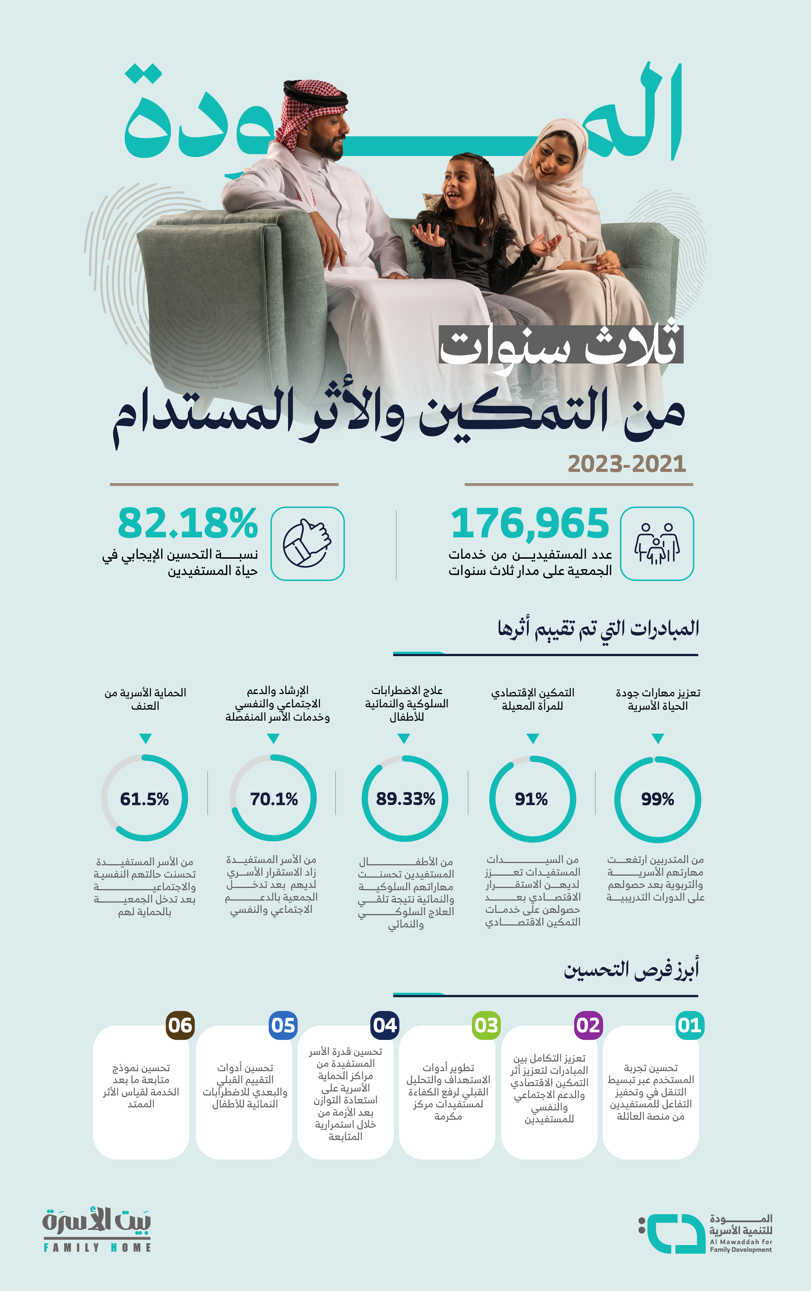
The Al Mawaddah Association for Family Development announced the results of its development impact report for the past three years. The results revealed an average positive impact of 82.18% on the lives of beneficiaries, achieved through a package of social, psychological, and economic programs focused on empowerment and achieving quality of life.
The Second Vice Chairman of the Board of Directors of the Al Mawaddah Association, Mr. Fayez bin Abdullah Al Harbi, explained that the association was able to reach 176,965 beneficiaries during this period, through qualitative interventions based on the real needs of Saudi families. The results showed that 99% of trainees improved their family and educational skills, 91% of female beneficiaries enhanced their economic stability after empowerment, and 89.33% of children's behavioral and developmental skills improved. Separated families also saw a 70.1% improvement in family stability, and violence protection services recorded an improvement in the psychological and social status of 61.5% of cases.
To ensure the professionalism and impartiality of the results, this report was prepared by a group of independent researchers, both male and female, who monitored and analyzed the data using scientific tools that ensure transparency and credibility.
The association relied on three main tools for data collection: periodic performance reports that documented the implementation of activities and the results achieved during the period from 2021 to 2023; electronic questionnaires distributed to beneficiaries to measure the impact of services; and direct phone calls that helped document personal experiences and monitor the social impact of initiatives.
Al-Harbi pointed out that the association does not stop at measuring impact, but rather views it as an opportunity for learning and improvement. He explained that the report identified several future development opportunities, most notably: improving the user experience by simplifying interaction on the family platform; enhancing integration between initiatives to increase the effectiveness of empowerment and support; and developing targeting and pre-analysis tools for the beneficiaries of the "Mukrama" Center. The association also seeks to enhance the ability of families benefiting from family protection centers to restore balance after crises through continuous monitoring, improving child distress assessment tools, and adopting new models to measure the impact beyond the service.
Al-Harbi concluded his statement by saying:
"The results achieved reflect our institutional efforts and our unwavering commitment to the family. We at Al-Mawaddah will continue to build on this impact to achieve greater stability and family awareness, in line with the goals of the Kingdom's Vision 2030."